

June 2026
Can’t you hear that
Boom, ba-data, boom, boom, ba-data, base?
We built that Supabase
Boom, ba-data, boom, boom, ba-data, base
Yeah, that’s that Supabase
Sorry, I had to. Did you know that song came out 15 years ago?! Did you even know I was referencing a song? How many of you reading this weren’t even working yet? How many questions in a row can I ask?
n8n Moves the Data. Supabase Holds It.
Last week, I wrote about how much n8n changed our entire workflow. This week, let’s talk about Supabase. I’ve dedicated two newsletters in the past year on why you should spend the time to set up a database. Like all software, LoanBoss is, at its core, a database, which enabled LoanBoss to put AI to work faster than Pensford.
Patience is not one of my virtues, so part of my March Madness project was to set up a database for Pensford. We chose Supabase and have been very happy.
Keep in mind, there is no existing, outsourced solution for interest rate data. If there was, I wouldn’t have built out Supabase. You have messy data that has been accumulated over time and you should put that in a database (if you come across data that could be handed off to someone else, you should outsource it. Data integrity is a full time gig, make it someone else’s problem if you can).
Having structured, consistent, and clean data has two gigantic benefits.
- Accuracy improves dramatically
- Tokens are spent on analysis, not wandering through a data mess
Here's the uncomfortable truth about AI: it's only as good as the data underneath it. You can wire up the slickest automation in the world, but point it at a messy spreadsheet and it will confidently make things up.
We learned that the hard way. We kept trying to treat Google Sheets and Smart Sheets as our databases. Those worked reasonably well for single, linear requests. But it became clear that we couldn’t run an organization off them.
When someone says “database,” I picture something like an Excel spreadsheet. But it isn’t, and those limitations became obvious as we tried to layer in AI on top of existing systems.
Here was a really critical lesson: Google Sheets is really just the UI for Google’s own databases. You wouldn’t try to turn your Yardi screens into a database, why are you trying to turn Google Sheets or Excel into a database? The answer is because you don't know any better and because, like me, you want to save money.
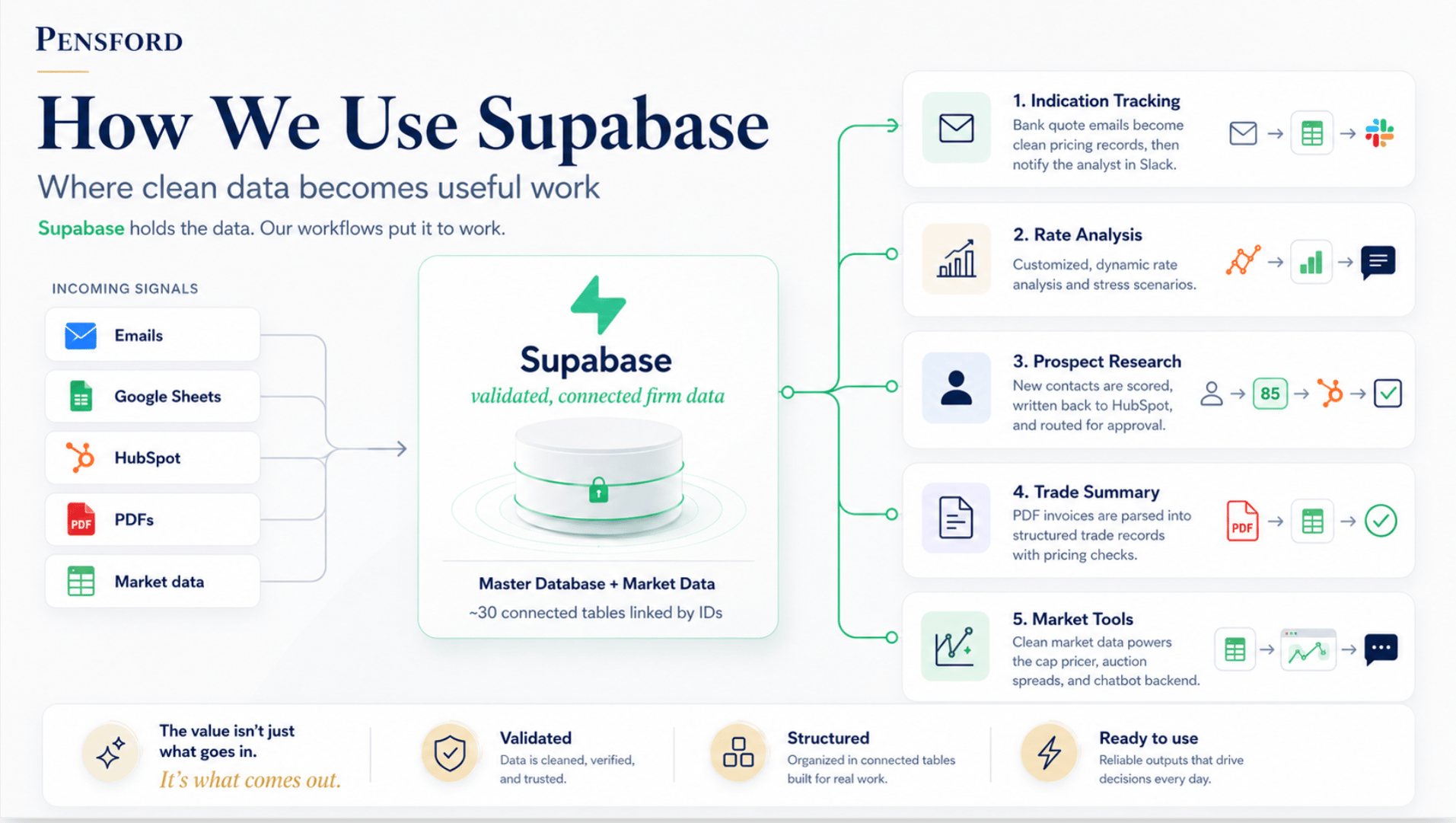
So we set out to build a database. After 3+ months, the Master Database is about 30 connected tables. Another big lesson for us? We have way more data than we realized. Emails, PDFs, Excel spreadsheets, rate analysis, etc. And versions of each of those. We had to convert all of that into structured data.
Heck, here’s a sample of just our active hedges:
- 7,183 active hedges, with structures/ratings/loan details
- 4,598 entities
- 1,817 sponsors
- 3,662 LEIs
Imagine Claude wandering around Google Sheets for a single hedge, then finding the appropriate LEI, creating a bid package, emailing the banks that meet the rating requirements, logging pricing, setting follow ups, etc. No chance.
We also have a Market Data database, and it is a beast: 34 million rows. Do you know what Excel’s max number of rows is? 1,048,576. We kept crashing computers figuring that out. Google sheets is actually worse - 10 million cells (not rows). Smartsheets? The least yet - 10,000 rows. Supabase? Infinite. It measures storage capacity, not rows.
Forward curves with every different type of index. Historical forward curves. Treasury and SOFR swap rates and historicals. Because we’re nerds, we even have historical FOMC dot plots. This database runs our live cap pricer, swap pricers, the auction spread system, hard core rate analysis for clients, and the chatbot backend.
Excel, Google Sheets, and SmartSheets are built for humans. They are effectively UI screens that feel like a database to real estate professionals.
Supabase is built for computers and is where software can reliably store, relate, query, and serve the data.
Why it Actually Changed Things
Two reasons, and neither is glamorous.
The data is connected, not flat. Every table is linked by individual ID codes, so a record pulls its full context instead of arriving as a lonely row. That context is the difference between an AI that answers correctly and one that guesses.
It validates as it goes. Enter a field wrong and the database catches it on the spot. The structure does the enforcing, preventing Claude from guessing. Everything has to be clean before a workflow ever touches it, which is exactly why the workflows can finally be trusted.
The Hard Part
This was much harder than implementing n8n, but largely because n8n is so painless. Building out Supabase was a 3 month project, mostly run by three people but needing access to other teammates. It also required some technical expertise, but I suspect most of you have similarly talented/skilled people.
This was not "hey Claude, build me a database." Claude Code did a huge amount of the building with a non-technical person driving, but you have to be specific, especially about the data, and you have to understand how the model reasons so you can fix what breaks. Low-code, not magic.
And boring.
So boring.
Guess who wasn’t working on it? This guy. Being the boss has to have its advantages, right?
Nobody wants to do the unglamorous data work that makes the AI usable. You ignored me when I suggested you build a database because it’s a pain, it’s boring, and you have a day job.
But that foundational work is the whole game. n8n is the half that got the spotlight. Supabase is the half that quietly holds it all together. The boring half is the important half.
Here’s a visualization of how it works for Pensford.
The combination of Claude, Supabase, and n8n is saving us thousands of hours each month. I know that sounds like an exaggeration, but it isn’t. It’s insane. We even got highlighted in CREAnalysts’ AI Survey.
Three months ago, I had no idea this would happen.
You will never have less data than you do right now, so you might as well commit to converting it to structured data that AI can leverage.
Next week, I’ll put a bow on the Claude/n8n/Supabase project and how we think about where our focus should be.